





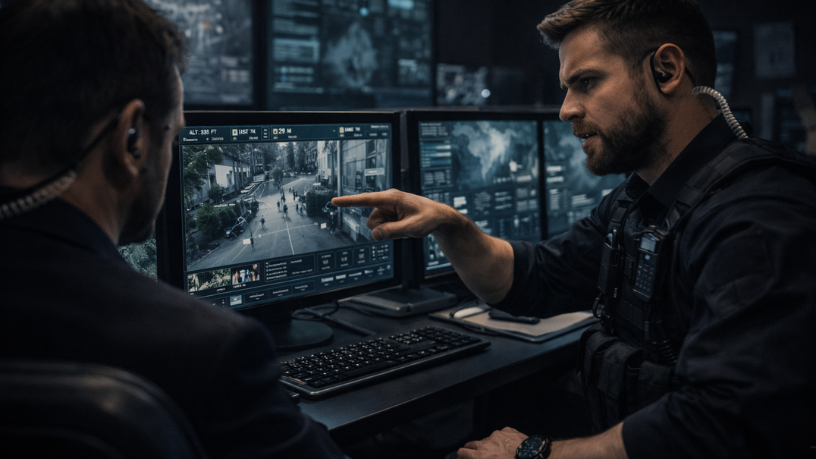
Ernesto Kenji Igarashi, a specialist in institutional security and executive protection, emphasizes that in institutional security operations, leadership plays a decisive role in mission stability. It is not merely about holding a command position, but about guiding the team with technical clarity and emotional balance. The quality of leadership directly influences both the safety of the authority being protected and overall operational efficiency.
When command is structured, the team operates with greater predictability and confidence. Conversely, disorganized decisions tend to increase risks and generate contradictory responses. Throughout this article, the main elements that characterize technical leadership in sensitive operations will be examined, including priority setting, team management, preparation for critical scenarios, strategic communication, and decision-making maturity.
Why Does Clearly Defining Priorities Prevent Hasty Decisions?
Defining priorities is one of the leader’s primary responsibilities in sensitive missions. As reinforced by Ernesto Kenji Igarashi through his practical experience, establishing what is essential within an operation reduces distractions and guides the team during high-pressure situations.
In this context, the leader must assess the scenario, identify critical points, and allocate resources strategically. This organization prevents impulsive decisions and keeps the focus on protecting the authority. Clear priorities strengthen team stability. When leadership demonstrates technical confidence, agents tend to perform with greater assurance.
How Does Team Management Influence Collective Performance?
Team management goes beyond simply assigning tasks. Based on his professional experience in the field, Ernesto Kenji Igarashi notes that leading in sensitive operations involves understanding each member’s competencies and positioning them strategically. In this environment, role organization must consider technical preparation, experience, and behavioral profile. This combination contributes to greater operational harmony.

Preparation for critical scenarios is one of the pillars of technical leadership. A leader must anticipate risks and structure contingency protocols even before the mission begins. This preventive approach enables quick and proportional responses to unexpected changes. Instead of improvising, command actions are based on prior planning. When the leader is technically prepared, the team feels more secure in executing its responsibilities.
Why Is Strategic Communication Decisive in High-Pressure Moments?
Strategic communication is the instrument that connects planning and execution. Technical decisions must be conveyed clearly to avoid misunderstandings and misinterpretations. In this regard, the leader must use objective and standardized language, ensuring that everyone understands the instructions.
Ernesto Kenji Igarashi emphasizes that efficient communication reduces isolated decisions and strengthens coordination. From an operational perspective, clear communication is one of the main factors of stability. When information flows in an organized manner, the mission unfolds more smoothly.
How Does Decision-Making Maturity Consolidate Command Authority?
Decision-making maturity is built throughout one’s professional trajectory. As observed in Ernesto Kenji Igarashi’s career, accumulated experience allows for more composed evaluation of complex scenarios. Over time, a leader learns to balance speed with technical analysis, avoiding impulsive decisions. This maturity strengthens internal credibility and team confidence.
This perspective highlights that technical leadership is not merely the result of hierarchy, but of continuous preparation and responsibility in decision-making. When priority definition, team management, strategic preparation, clear communication, and decision-making maturity operate in an integrated manner, institutional security remains solid even in high-risk environments.
Author: Diego Rodríguez Velázquez