



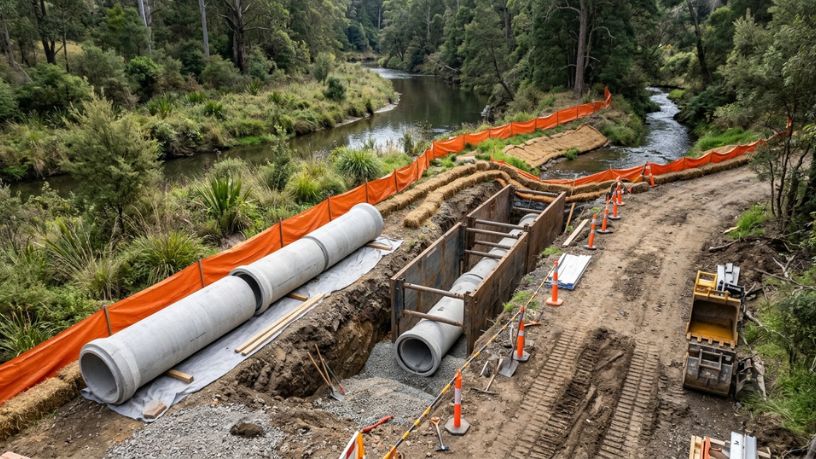
In the view of environmental engineer Felipe Schroeder dos Anjos, the rapid pace of sanitation infrastructure projects in Brazil brings a challenge that receives little attention. The Legal Framework for Sanitation requires that, by 2033, 99% of the population have access to drinking water and 90% have access to sewage collection and treatment. To meet these targets, the country must dig trenches, install networks, and build treatment plants at an accelerated pace, and each of these interventions also generates environmental impacts.
Planning and Licensing Before the First Excavation
The first stage takes place on paper. Environmental licensing for sanitation projects typically involves three phases: the preliminary license, which assesses the project’s feasibility and location; the installation license, which authorizes construction to begin; and the operating license. During the design phase, evaluating alternative routes helps avoid permanent preservation areas and flood-prone land.
A site assessment completes the planning process. Mapping underground infrastructure, such as gas networks, cables, and other pipelines, reduces the risk of accidents and rework. The project must also account for soil type, groundwater depth, and the daily routines of the affected community, Felipe Schroeder dos Anjos points out, since these factors determine the most appropriate construction method.
Choosing the Construction Method
Trenchless methods are the main alternative for reducing environmental impacts. Horizontal directional drilling and pipe jacking make it possible to install networks without opening trenches along the entire route. The result is less excavation, reduced debris generation, less traffic disruption, and a lower need for vegetation removal in sensitive areas. When crossing rivers, highways, and railways, these techniques avoid direct interventions in riverbeds or road surfaces.
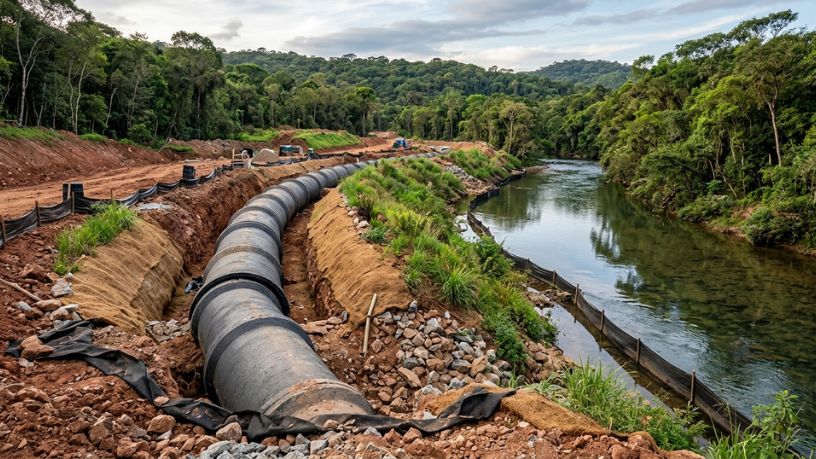
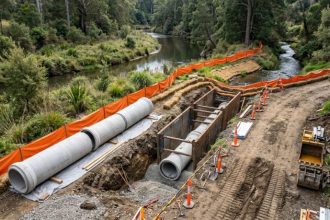
When open-cut trenching is unavoidable, strict controls are essential. Slope stabilization prevents collapses, while sediment barriers keep excavated soil from being carried by rain into streams and storm drains. Lowering the groundwater table, which is common in wet areas, also requires monitoring to avoid affecting nearby buildings. Water pumped from trenches, in turn, must undergo sedimentation before being discharged into the urban drainage system.
Construction Waste Also Needs Proper Disposal
Every construction project generates waste, and sanitation projects are no exception. CONAMA Resolution No. 307/2002 classifies construction and demolition waste into categories, guiding its separation at the construction site. As Felipe Schroeder dos Anjos notes, excavated soil can be reused for backfilling and earthworks, provided it is not contaminated.
The waste management plan organizes this process. It establishes how each material will be separated, stored, transported, and disposed of, always at licensed facilities. Concrete and ceramic materials can be crushed and converted into recycled aggregates, while hazardous waste, such as oils and solvents, requires specific disposal methods. Transport manifests make it possible to track each load and demonstrate during inspections that the material reached the correct destination.
Monitoring From Construction Through Operation
During construction, environmental monitoring must be continuous. Noise, dust, water quality in nearby rivers, and the movement of heavy machinery must be monitored in accordance with the conditions set out in the environmental license. Communication channels with residents help anticipate problems and reduce neighborhood conflicts. Providing advance notice of street closures, working hours, and traffic detours reduces complaints and increases community acceptance of the project.
Environmental responsibility does not end when construction is completed. Degraded areas must be restored through vegetation recovery, and treatment plants must operate within effluent discharge standards. According to Felipe Schroeder dos Anjos, this continuity between construction and operation ensures that sanitation projects deliver the promised environmental benefits. A well-built sewage network that is poorly operated can transfer pollution from one location to another instead of eliminating it.