




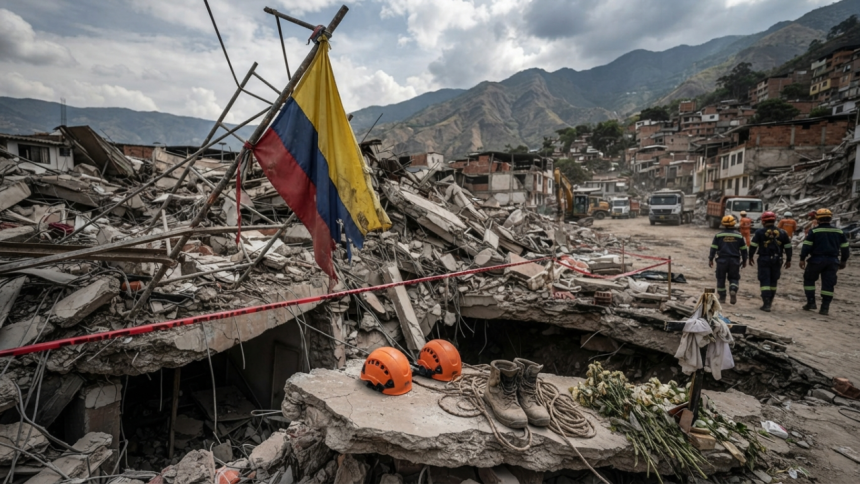
Rescue crews across western Colombia are racing against time as the search for survivors of Monday’s devastating earthquake entered what officials called its “final phase” this week, with the window for finding people alive beneath collapsed buildings narrowing by the hour.
The magnitude 7.4 quake, the strongest to strike Colombia in this century, has killed at least 265 people, injured more than 3,700 others, and left nearly 500 people still reported missing, according to the country’s government.
A Disaster That Struck Colombia’s Coffee-Growing Heartland
The earthquake’s epicenter was located in San José del Palmar, in the northwestern department of Chocó, roughly 150 miles west of the capital, Bogotá. Tremors were felt as far away as neighboring Ecuador and Panama, but the heaviest damage was concentrated in Colombia’s coffee-growing region, hitting the cities of Cali, Pereira, Quibdó and Manizales hardest. In Pereira, a city of more than half a million people, electricity was knocked out almost entirely, forcing many residents to spend the first night sleeping in the streets, either fearing aftershocks or because their homes had been damaged beyond safe use.
The disaster has become an unexpected first test for Colombia’s newly inaugurated president, Abelardo de la Espriella, who had been in office for only three days when the quake struck. He declared a state of national disaster within hours and said he would “personally lead efforts” to coordinate the rescue response, deploying soldiers to the hardest-hit areas alongside emergency crews. By Wednesday, the government reported that 61 buildings had collapsed outright and more than 1,575 homes had sustained damage, along with 18 health centers, 52 educational centers, and 17 community centers.
Volunteers Working With Their Bare Hands
In the earthquake’s immediate aftermath, ordinary residents became first responders. In Cali, volunteers formed human chains to clear bricks and masonry by hand, pausing every few minutes to listen for any sign of life beneath the rubble. Andres Felipe Mejia, who joined one of the makeshift rescue crews, described a moment of hope near a collapsed building: “One of the rescuers asked anyone trapped to whistle, and someone whistled back.” Similar scenes played out at Pereira’s airport, where video showed ceiling debris falling on travelers sheltering during the initial quake, and at a partially collapsed hospital in Cali, where several patients remained trapped in the wreckage.
International Rescue Teams Join the Effort
As the search intensified, international assistance began arriving from multiple countries, including a Mexican rescue team that was photographed searching through rubble in Cali two days after the quake. Leaders from the United States, elsewhere in South America, Europe, and the Middle East have pledged support for the recovery effort, though the scale of destruction across multiple cities has stretched the capacity of both domestic and international responders.
Emergency and disaster experts widely recognize the first 72 hours after a major earthquake as the period offering the best odds of finding survivors alive, sometimes referred to as the “golden window.” Factors that improve survival chances after that period narrows include access to oxygen, water, and food while trapped, as well as a person’s overall health, since those with preexisting conditions or major internal injuries face significantly lower odds of survival the longer rescue efforts take. In neighboring Venezuela, a man was successfully rescued eight days after earthquakes struck that country in June, a reminder that survival beyond the golden window, while rare, remains possible.
Overwhelmed Morgues and Rising Casualty Counts
The scale of casualties has overwhelmed local infrastructure in the hardest-hit cities. In Cali, the city’s public health secretary, German Escobar, said the morgue had reached capacity as authorities worked to bring additional bodies in from the streets. Traffic restrictions were lifted in the city to allow a steady stream of dump trucks to haul rubble away from collapse sites, even as many traffic lights remained out and temperatures climbed toward 86 degrees Fahrenheit, adding to the physical strain on rescue workers.
For residents like Gloria Giraldo, a 38-year-old homemaker in Pereira whose neighborhood was leveled, the days since the earthquake have been defined by uncertainty about what comes next. “Since yesterday we’ve been wondering what will become of our lives,” she told the French news agency AFP, describing a night spent navigating blacked-out streets by torchlight. Temporary medical facilities have been set up in gymnasiums and school buildings to treat patients evacuated from damaged clinics, while Red Cross volunteers in Bogotá worked to organize donated food and supplies for distribution to the affected regions.
What Comes Next for Colombia
As the search for survivors winds down in the coming days, attention is expected to shift toward the far longer process of rebuilding, with the government already signaling plans for economic emergency measures to address the crisis. With the earthquake now ranked as the strongest to hit the country in a decade, and among the deadliest natural disasters in the region in recent memory, the coming weeks will test both the resilience of affected communities and the capacity of Colombia’s government, barely a week into its term, to manage a recovery effort of this scale.