

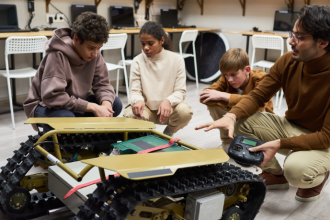



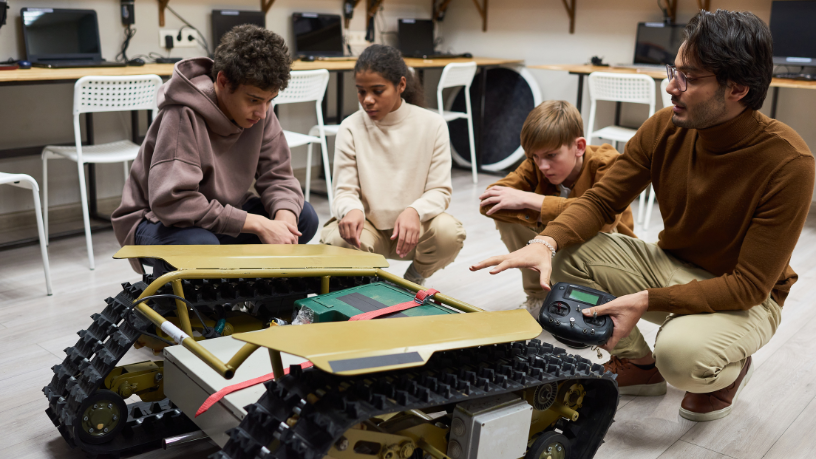
As highlighted by education specialist and entrepreneur Sergio Bento de Araujo, interdisciplinary robotics has been consolidating itself as a pedagogical approach capable of integrating different areas of knowledge in a practical and meaningful way. By combining mathematics, physics, and programming in concrete activities, robotics allows abstract concepts to gain meaning through experimentation, problem-solving, and collaborative work. Instead of learning content in isolation, students begin to understand it as interdependent parts of a single process.
When theory and practice come together, learning gains meaning. Continue reading and discover how interdisciplinary robotics connects knowledge areas and transforms the educational experience.
How does interdisciplinary robotics integrate mathematics, physics, and programming in practice?
According to Sergio Bento de Araujo, interdisciplinary robotics integrates mathematics, physics, and programming by requiring these areas of knowledge to be used simultaneously in the construction and operation of prototypes. For a robot to move correctly, for example, it is necessary to calculate distances, angles, and speeds, applying mathematical concepts in a concrete and contextualized way.
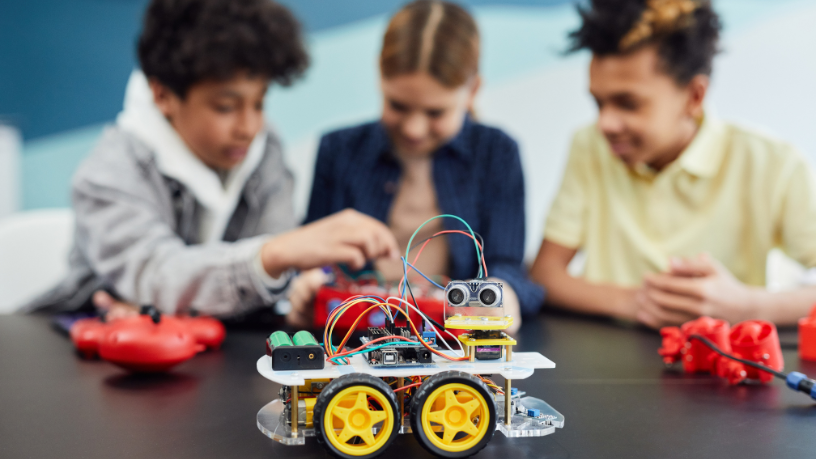
Physics serves as the foundation for understanding phenomena such as force, torque, friction, energy, and motion. By testing a robot on different surfaces or adjusting the weight of its components, students observe in practice how physical laws influence project performance. This turns theoretical content into observable and analyzable experiences.
Programming, in turn, acts as the element of control and logic. Through code, students define commands, sequences, conditions, and the robot’s responses to the environment. This process develops logical reasoning and demonstrates how mathematics and physics are translated into instructions that guide the behavior of automated systems.
What competencies are developed through the interdisciplinary robotics approach?
Interdisciplinary robotics contributes to the development of both cognitive and socio-emotional competencies. From a cognitive perspective, students learn to solve complex problems, as they must analyze situations, formulate hypotheses, test solutions, and correct errors. According to education specialist and entrepreneur Sergio Bento de Araujo, this cycle strengthens critical thinking and adaptability.
Furthermore, interdisciplinarity encourages an integrated understanding of knowledge. Instead of viewing mathematics, physics, and programming as disconnected subjects, students begin to see how they complement one another. This perspective enhances the ability to transfer learning to new contexts, an essential skill for academic and professional development.
Why does interdisciplinary robotics strengthen meaningful learning?
Meaningful learning occurs when students are able to relate new knowledge to concrete experiences and prior understanding. Robotics provides exactly this scenario, as it places students at the center of the learning process, engaged in real and contextualized challenges.
By building and programming robots, students see purpose in the content they study. Mathematical formulas cease to be abstractions and acquire practical function; physical concepts become observable; programming gains a clear purpose. According to Sergio Bento de Araujo, this connection between theory and practice increases engagement and knowledge retention.
Author: Clodayre Daine