





Among the most promising concepts of the circular economy applied to industry, Marcello José Abbud, director of Ecodust Ambiental, highlights industrial symbiosis as a model capable of redefining how companies relate to their waste. The core idea is elegant in its simplicity: the waste generated by one industry can become the input required by another, creating exchange networks in which materials, water, and energy circulate among companies rather than being discarded. What remains from one production process becomes the fuel for another.
This model reverses the traditional linear logic, in which each company extracts resources, produces goods, and disposes of waste independently. In industrial symbiosis, geographic proximity and complementarity among processes transform a group of companies into a productive ecosystem, where the concept of waste tends to disappear, replaced by the norm of shared resource flows.
How Do Material Exchange Networks Between Companies Work?
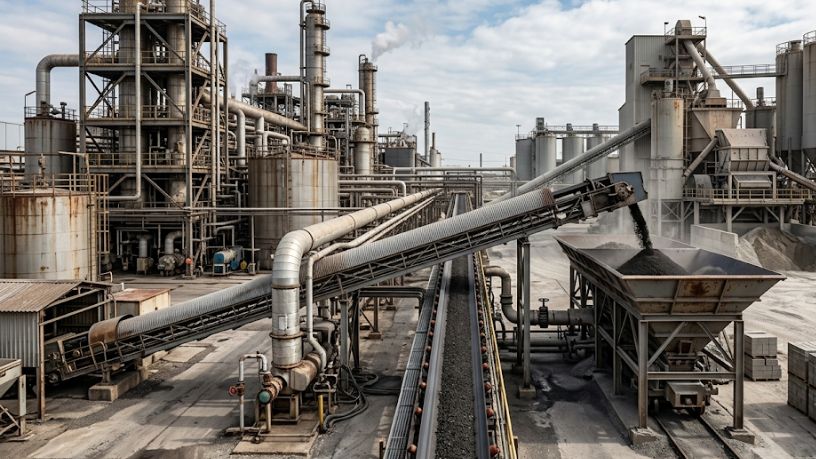
Industrial symbiosis takes shape through arrangements in which a company’s by-products are systematically directed to another company that uses them as raw materials. Ash from combustion processes can serve the cement industry, residual steam from one plant can heat the processes of a neighboring facility, and organic waste from an agribusiness operation can support energy generation or fertilizer production at another site. The possibilities multiply as the diversity of companies within the same territory increases.
As Marcello José Abbud explains, the most famous example of this model was established in a Danish industrial district, where several companies built, over decades, a dense network of material and energy exchanges. This case demonstrated that symbiosis is not merely an environmental theory but an economically advantageous model capable of simultaneously reducing both input and disposal costs for all participants in the network.
The Economic and Environmental Benefits of the Approach
Industrial symbiosis delivers benefits across multiple dimensions. From an environmental perspective, it reduces the extraction of natural resources, decreases the volume of waste sent to landfills, and cuts emissions associated with both the production of virgin materials and waste treatment. From an economic standpoint, companies save money on raw material purchases and waste disposal, turning two separate costs into a shared value transaction.
In Marcello José Abbud’s view, this alignment between economic interests and environmental benefits is what gives industrial symbiosis its transformative power. When reducing waste and conserving resources translates directly into cost reductions and revenue generation, sustainability no longer depends solely on regulatory requirements but is instead driven by the business logic of the companies involved.
What Conditions Enable Industrial Symbiosis?
The formation of industrial symbiosis networks does not occur spontaneously; it depends on specific conditions. Geographic proximity between companies reduces transportation costs that could otherwise make exchanges unfeasible. Sectoral diversity increases the likelihood of complementarity between waste streams and inputs. In addition, shared information about each company’s material flows is essential for identifying exchange opportunities that would otherwise remain invisible.
From this perspective, Marcello José Abbud examines the role of coordination and governance in these arrangements. A coordinating agent is often necessary—whether an industrial association, a specialized operator, or the public sector itself—to map material flows, connect companies, and structure transactions. Without such coordination, the symbiotic potential within an industrial hub remains untapped simply because companies lack mutual awareness of available opportunities.
The Potential of Industrial Symbiosis in Brazil
Brazil offers favorable conditions for the development of industrial symbiosis, with numerous industrial hubs and districts that bring together companies from diverse sectors in close geographic proximity. These clusters provide the ideal foundation for mapping waste streams and identifying exchange opportunities that currently go unnoticed, as each company treats its by-products in isolation as a disposal problem.
In light of this scenario, Marcello José Abbud argues that the advancement of industrial symbiosis in Brazil depends on initiatives that structure the mapping of material flows and foster connections among companies. Digital platforms that match waste supply with demand, development programs, and incentives for sustainable industrial parks are tools capable of catalyzing these networks, transforming the latent potential of Brazilian industrial clusters into genuinely circular productive ecosystems.
Author: Diego Rodríguez Velázquez