
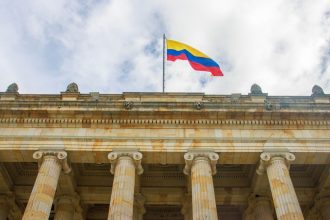

Colombia’s presidential runoff has added a significant new chapter to Latin America’s conservative advance, according to the Associated Press. The election of Trump-backed candidate De la Espriella places one of South America’s most important U.S. partners under a political leadership that has emphasized public security, market-oriented economic policies and closer alignment with Washington.
The result, reported by The Associated Press on June 24, 2026, is relevant beyond Colombia’s borders. Bogotá plays an important role in discussions involving drug trafficking, migration, regional security and relations with Venezuela. A change in the country’s political orientation may therefore affect how those issues are addressed across the hemisphere.
A broader conservative advance
AP’s regional analysis, published two days before the Colombian result, described a wider movement in which conservative politicians have gained ground in Latin America. The trend also includes Peru and Argentina, where candidates and governments have drawn support by focusing on crime, economic concerns and stronger connections with the United States.
According to the Associated Press, the movement is not uniform. Each country is responding to its own political system, economic conditions and security pressures. Even so, the repeated emphasis on public order, border control and closer ties with the Trump administration indicates that conservative forces have found a common political language across parts of the region.
Colombia’s result is particularly notable because the country has long occupied a central position in U.S. policy toward South America. Its geographic location, role in migration routes and exposure to organized crime have made security cooperation a defining element of its international relationships. A government that gives greater priority to those issues could seek a different tone in its dealings with Washington and with neighboring countries.
Implications for Washington and the region
De la Espriella’s association with President Donald Trump gives the election an immediate hemispheric dimension. It signals that Colombia’s next administration is likely to be viewed through the lens of the broader political relationship between the United States and Latin America, rather than only through domestic debates.
That relationship may become more closely connected to questions of migration and organized crime. Colombia is an important actor in regional conversations on both subjects, and changes in its security priorities could influence cooperation with the United States and the positions adopted in South American diplomacy. Venezuela policy is another area in which Bogotá’s orientation may carry consequences beyond its own territory.
The shift also reflects a political contest over the meaning of stability in Latin America. Conservative candidates have increasingly presented stronger policing, tighter control of borders and market-friendly policies as answers to public frustration. Progressive forces, meanwhile, continue to compete for voters concerned with inequality, social protections and the role of the state. The Colombian election shows that the balance between these approaches remains unsettled.
Why the result matters to Brazil
For Brazil, Colombia’s political transition matters because it changes the balance among the region’s major powers. Brazil remains one of Latin America’s principal counterweights to U.S. influence, while Colombia has historically been one of Washington’s closest partners in South America. A more conservative government in Bogotá could produce sharper differences over regional priorities and diplomatic coordination.
Those differences would not necessarily eliminate cooperation. Countries across the continent still share practical concerns involving migration, organized crime, trade and border security. However, a more pronounced ideological divide could make joint initiatives more difficult, particularly when governments disagree over the preferred role of the United States in regional affairs.
The development also offers an early indication of the political environment surrounding Brazil’s 2026 election. Brazil’s own electoral outcome will shape its relationship with Washington and its neighbors, but Colombia’s result demonstrates that voters in the region are responding to security and economic arguments that cross national borders.
Colombia’s runoff does not establish a single political model for Latin America. It does, however, reinforce the visibility of conservative forces at a moment when governments and voters are reassessing security, migration, economic policy and relations with the United States. The incoming administration in Bogotá will now become a key test of how that regional shift translates into diplomacy and policy.