






Physician Haeckel Cabral Moraes explains that gluteoplasty has become one of the most sought-after procedures among individuals who wish to improve the projection and firmness of the posterior body region. The search for a harmonious gluteal contour involves a detailed analysis of the proportions between the hips, thighs, and waist.
This procedure allows both volume enhancement and the correction of asymmetries or sagging caused by aging or significant weight loss. Continue reading to understand which technique best suits your aesthetic goals.
What is gluteoplasty and what are the main techniques used?
Glute contouring surgery can be performed through two main methods that address different needs regarding volume and texture. According to physician Haeckel Cabral Moraes, silicone implant placement is the most suitable technique for patients with low body fat who desire a more pronounced and firmer projection.
On the other hand, gluteal fat grafting, also known as the Brazilian Butt Lift, uses the patient’s own fat removed from other areas to sculpt the region. This second option offers the additional advantage of refining the contour of donor areas, such as the abdomen and flanks, creating a much more defined waistline. Furthermore, the choice between implants and fat grafting depends on a careful evaluation of the patient’s skin elasticity and fat tissue availability.
How is glute contouring performed in surgical practice?
The surgical procedure begins with planning the projection vectors that will be prioritized to create the desired shape, whether rounder or more laterally projected. For physician Haeckel Cabral Moraes, the incision for implant placement is strategically positioned in the intergluteal crease, making the final scar discreetly hidden.
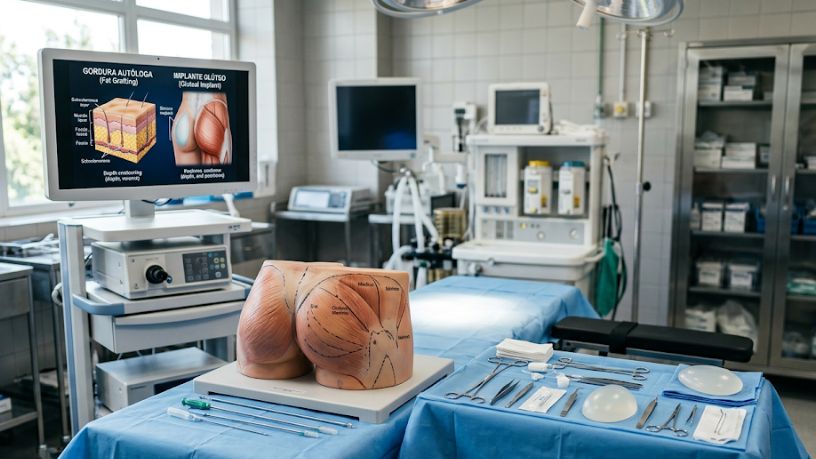
Through this access point, the surgeon creates the necessary space for the implant, focusing on symmetry between both sides. In the case of fat grafting, the fat is injected into multiple subcutaneous layers to ensure uniform filling free from surface irregularities. In addition, the duration of the surgery and the type of anesthesia used vary according to the extent of the procedure and whether it is combined with other interventions, such as liposuction.
Essential care and the stages of post-operative recovery
The success of glute contouring depends directly on the patient’s commitment to the care required in the weeks following the surgical procedure. As highlighted by physician Haeckel Cabral Moraes, controlling swelling and protecting the sutures are essential to preserve the shape defined during surgery. The body needs time to properly integrate the fat graft or adapt safely and comfortably to the presence of silicone implants. For this reason, respecting postural restrictions becomes indispensable to avoid displacement, asymmetries, or volume loss in the operated area.
Among the main post-operative care measures are the continuous use of compression garments, avoiding direct pressure on the glutes, and undergoing lymphatic drainage sessions according to medical guidance. It is also necessary to avoid intense physical exercise and maintain a balanced diet combined with adequate hydration to promote cellular regeneration and the stability of the results.
The importance of glute contouring
Gluteoplasty represents the union between medical material technology and the refinement of body sculpting techniques. As physician Haeckel Cabral Moraes summarizes, harmonizing this region positively impacts clothing fit, posture, and the self-confidence of both men and women.
By choosing the method that best respects their biology and by following the recommended medical care, patients ensure a safe and aesthetically pleasing transformation. The final result is a more balanced silhouette that reflects health, vitality, and care for one’s image in an integrated and natural way.
Author: Diego Rodríguez Velázquez