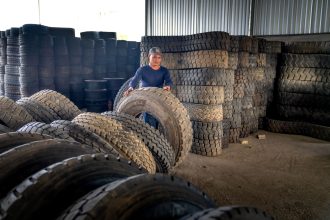


The United States has asked Mexico to investigate alleged labor rights violations at Yokohama Tire Manufacturing Mexico, a tire facility in the state of Coahuila. The request, announced on September 25, 2026, was made under the United States-Mexico-Canada Agreement’s Rapid Response Labor Mechanism.
According to the United States Trade Representative, the allegations were submitted by the Liga Sindical Obrera Mexicana and the International Lawyers Assisting Workers Network. The petition claims that employees who supported the union were subjected to unequal treatment and dismissals, while union representatives allegedly faced restricted access to the facility.
The petition also alleges irregularities linked to a vote on union representation. These claims have not been finally adjudicated. The U.S. action represents a request for Mexico to review the allegations, rather than a final determination that the company or its workers violated labor law.
Mexico faces a 10-day decision window
Mexico has 10 days to agree to conduct the review. If the Mexican government accepts the request, it will have 45 days to investigate the allegations and provide its findings to the United States.
The timetable is part of the facility-specific process established under the USMCA. The mechanism allows the United States and Mexico to address alleged denials of workers’ rights to freedom of association and collective bargaining at individual facilities, rather than limiting enforcement to broad disputes between governments.
The U.S. Trade Representative’s overview of the Rapid Response Labor Mechanism states that the process can lead to trade-related action in certain circumstances. Possible measures include the suspension of tariff benefits or other restrictions on goods connected to a facility found to be non-compliant.
Trade measures applied while review proceeds
As an immediate step, Washington said it would suspend the liquidation of entries involving goods from the Mexican facility while the review moves forward. In customs practice, liquidation is the process through which an entry is finalized and duties are determined, making the suspension a way to preserve the possibility of further action during the investigation.
The development comes as North American manufacturing remains closely integrated. Mexico, the United States and Canada share production networks across industrial and automotive sectors, meaning a labor dispute at one plant can have consequences beyond the workplace. It may affect customs procedures, imports, union activity and discussions about enforcement under the regional trade agreement.
The case also follows the closure of Yokohama’s tire plant in Salem, Virginia, and the layoff of nearly 600 workers in the United States. The U.S. Trade Representative included that development in its announcement, adding a domestic dimension to a dispute centered on an industrial facility in Mexico.
A test for USMCA labor enforcement
The Yokohama case places attention on how the USMCA labor provisions operate at the plant level. Rather than waiting for a wider diplomatic disagreement, the Rapid Response Labor Mechanism provides a channel for governments and eligible organizations to raise concerns about labor rights at a specific facility.
The mechanism’s use in Coahuila could also become relevant to the broader 2026 review of the USMCA. Labor enforcement is one of the agreement’s central provisions, and the case gives policymakers a concrete example of how allegations involving union representation and collective bargaining can move through the agreement’s procedures.
At this stage, the allegations remain under review. The next key step is Mexico’s decision on whether to accept the request. If it does, the investigation and the findings submitted within the 45-day period will determine how the governments assess the claims and whether additional trade-related measures are considered.
Sources and procedural context
The announcement and the explanation of the mechanism were published by the United States Trade Representative. Its materials describe how labor petitions can be raised under the USMCA and distinguish the initial review request from any later findings or enforcement action.